
(by Fr. Prosper Gueranger 1870)
The sun of the fortieth day has risen in all his splendor. The earth, which shook with gladness at the Birth of our Emmanuel (Ps. xcv. xcvi. xcvii.), now thrills with a strange emotion. The divine series of the mysteries of the Man-God is about to close. Heaven has caught up the joy of earth. The Angelic Choirs are preparing to receive their promised King, and their Princes stand at the Gates, that they may open them when the signal is given of the mighty Conqueror's approach (Ibid. xxiii. 7). The holy souls, that were liberated from Limbo on the morning of the Resurrection, are hovering round Jerusalem, waiting for the happy moment when Heaven's gate, closed by Adam's sin, shall be thrown open, and they shall enter in company with their Redeemer: a few hours more, and then to Heaven! Meanwhile, our Risen Jesus has to visit His Disciples and bid them farewell, for they are to be left, for some years longer, in this vale of tears.
They are in the Cenacle, impatiently awaiting His coming. Suddenly He appears in their midst. Of the Mother's joy, who would dare to speak? As to the Disciples and the holy Women, they fall down and affectionately adore the Master, Who has come to take His leave of them. He deigns to sit down to table with them; He even condescends to eat with them, not, indeed, to give them proof of His Resurrection, for He knows that they have no further doubts of the mystery, but now that He is about to sit at the right hand of the Father, He would give them this endearing mark of familiarity. O admirable repast! in which Mary, for the last time in this world, is seated side by side with her Jesus, and in which the Church, (represented by the Disciples and the holy Women,) is honored by the visible presidency of her Head and Spouse.
What tongue could describe the respect, the recollected mien, the attention of the guests? With what love must they not have riveted their eyes on the dear Master? They long to hear him speak; his parting words will be so treasured! He does not keep them long in suspense; He speaks, but his language is not what they perhaps expected it to be, all affection. He begins by reminding them of the incredulity wherewith they heard of His Resurrection (St. Mark, xvi. 14). He is going to entrust His Apostles with the most sublime mission ever given to man; He would, therefore, prepare them for it by humbling them. A few days hence, and they are to be lights of the world; the world must believe what they preach, believe it on their word, believe it without having seen, believe what the Apostles alone have seen. It is by Faith that man approaches His God: they themselves were once without it, and Jesus would have them now express their sorrow for their former incredulity, and thus base their Apostolate on humility.
Then assuming a tone of authority, such as none but a God could take, He says to them: Go ye into the whole world, and preach the Gospel to every creature. He that believeth and is baptized, shall be saved: but he that believeth not, shall be condemned (Ibid. xvi. 15, 16). And how shall they accomplish this mission of preaching the Gospel to the whole world? how shall they persuade men to believe their word? By Miracles. And these signs, continues Jesus, shall follow them that believe: in My name, they shall cast out devils; they shall speak with new tongues; they shall take up serpents; and if they shall drink any deadly thing, it shall not hurt them; they shall lay their hands upon the sick, and they shall recover (St. Mark, svi. 17, 18). He would have Miracles to be the foundation of his Church, just as He had made them the argument of His own divine mission. The suspension of the laws of nature proves to us that it is God Who speaks; we must receive the word, and humbly believe it.
Here, then, we have men unknown to the world and devoid of every human means, and yet commissioned to conquer the earth and make it acknowledge Jesus as its King! The world ignores their very existence. Tiberius, who sits on the imperial throne, trembling at every shadow of conspiracy, little suspects that there is being prepared an expedition which is to conquer the Roman Empire. But these warriors must have their armour, and the armour must be of heaven's own tempering. Jesus tells them that they are to receive it a few days hence. Stay, says He, in the city, till ye be endued with power from on high (St. Lluke, xxiv. 49). But what is this armour? Jesus explains it to them. He reminds them of the Father's promise, that promise, says He, which ye have heard by my mouth: for John, indeed, baptized with water; but ye shall be baptized with the Holy Ghost not many days hence (Acts, i. 4, 5).
But the hour of separation is come. Jesus rises: His blessed Mother, and the hundred and twenty persons assembled there, prepare to follow Him. The Cenacle is situated on Mount Sion, which is one of the two hills within the walls of Jerusalem. The holy group traverses the city, making for the eastern Gate, which opens on the Valley of Josaphat. It is the last time that Jesus walks through the faithless City. He is invisible to the eyes of the people who denied Him, but visible to His Disciples, and goes before them, as, heretofore, the pillar of fire led on the Israelites. How beautiful and imposing a sight! Mary, the Disciples, and the holy Women, accompanying Jesus in His Heaven-ward journey, which is to lead Him to the right hand of His Eternal Father! It was commemorated in the Middle-Ages by a solemn Procession before the Mass of Ascension Day. What happy times were those, when Christians took delight in honouring every action of our Redeemer! They could not be satisfied, as we are, with a few vague notions, which can produce nothing but an equally vague devotion.
They reflected on the thoughts which Mary must have had during these last moments of her Son's presence. They used to ask themselves, which of the two sentiments were uppermost in her maternal heart, sadness, that she was to see her Jesus no more? or joy, that He was now going to enter into the glory He so infinitely deserved? The answer was soon found: had not Jesus said to His Disciples: If ye loved me, ye would indeed be glad, because I go to the Father (St. John, xiv. 28)? Now, who loved Jesus as Mary did? The Mother's heart, then, was full of joy at parting with Him. How was she to think of herself, when there was question of the triumph of her Son and her God? Could she that had witnessed the scene of Calvary do less than desire to see Him glorified, Whom she knew to be the Sovereign Lord of all things, Him Whom, but a short time ago, she had seen rejected by His people, blasphemed, and dying the most ignominious and cruel of deaths?
The holy group has traversed the Valley of Josaphat; it has crossed the brook Cedron, and is moving onwards to Mount Olivet. What recollections would crowd on the mind! This torrent, of which Jesus had drunk on the day of His humiliation, is now the path He takes to triumph and glory. The Royal Prophet had foretold it (Ps. cix. 7). On their left, are the Garden and Cave, where He suffered His Agony and accepted the bitter Chalice of His Passion. After having come as far as what St. Luke calls the distance of the journey allowed to the Jews on a sabbath-day (Acts, i. 12), they are close to Bethania, that favoured village, where Jesus used to accept hospitality at the hands of Lazarus and his two Sisters. This part of Mount Olivet commands a view of Jerusalem. The sight of its Temple and Palaces makes the Disciples proud of their earthly city: they have forgotten the curse uttered against her; they seem to have forgotten, too, that Jesus has just made them citizens and conquerors of the whole world. They begin to dream of the earthly grandeur of Jerusalem, and, turning to their Divine Master, they venture to ask him this question: Lord, wilt thou, at this time, restore again the kingdom to Israel (Acts, i. 6)?
Jesus answers them with a tone of severity: It is not for you to know the times or moments which the Father hath put in His own power (Ibid. 7). These words do not destroy the hope that Jerusalem is to be restored by the Christian Israel; but, as this is not to happen till the world is drawing towards its end, there is nothing that requires our Saviour's revealing the secret. What ought to be uppermost in the mind of the Disciples, is the conversion of the pagan world, the establishing the Church. Jesus reminds them of the mission He has just given to them: Ye shall receive, says He, the power of the Holy Ghost coming upon you; and ye shall be witnesses unto Me in Jerusalem, and in all Judea, and Samaria, and even to the uttermost part of the earth (Acts, i. 8).
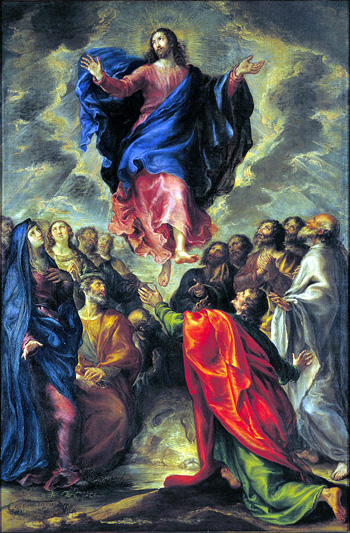
According to a tradition, which has been handed down from the earliest ages of Christianity (Constit. Apost., lib. v. cap. xix), it is mid-day, the same hour that He had been raised up, when nailed to His Cross. Giving His Blessed Mother a look of filial affection, and another of fond farewell to the rest of the group that stand around him, Jesus raises up His hands and blesses them all. Whilst thus blessing them, He is raised up from the ground whereon He stands, and ascends into heaven (St. Luke, xxiv. 51). Their eyes follow Him, until a cloud comes and receives Him out of their sight (Acts, i. 9).
Yes, Jesus is gone! The earth has lost her Emmanuel! For four thousand years had He been expected: the Patriarchs and Prophets had desired His coming with all the fervour of their souls: He came: His love made Him our captive in the chaste womb of the Virgin of Nazareth. It was there He first received our adorations. Nine months after, the Blessed Mother offered Him to our joyous love in the Stable at Bethlehem. We followed Him into Egypt; we returned with Him; we dwelt with Him at Nazareth. When He began the three years of His public Life, we kept close to His steps; We delighted in being near Him, we listened to His preaching and parables, we saw His miracles. The malice of His enemies reached its height, and the time came wherein He was to give us the last and grandest proof of the love that had brought Him from heaven, His dying for us on a Cross; we kept near Him as He died, and our souls were purified by the Blood that flowed from His Wounds. On the third day, He rose again from His Grave, and we stood by exulting in His triumph over Death, for that triumph won for us a like Resurrection. During the Forty days He has deigned to spend with us since His Resurrection, our faith has made us cling to Him: we would fain have kept Him with us forever, but the hour is come; He has left us; yes, our dearest Jesus is gone! O happy the souls that He had taken from Limbo! they have gone with Him, and, for all eternity, are to enjoy the heaven of His visible presence.
The Disciples are still steadfastly looking up towards heaven, when lo! two angels, clad in white robes, appear to them, saying: Ye men of Galilee! why stand ye looking up to heaven? This Jesus, Who is taken up from you into heaven, shall so come as ye have seen Him going into heaven (Acts, i. 10, 11)! He has ascended, a Saviour; He is to return, as Judge; between these two events is comprised the whole life of the Church on earth. We are therefore living under the reign of Jesus as our Saviour, for He has said: God sent not His Son into the world to Judge the world, but that the world might be Saved by Him (St. Joh, iii. 17): and to carry out this merciful design He has just been giving to His Disciples the mission to go throughout the whole world, and invite men, whilst yet there is time, to accept the mystery of Salvation.
What a task is this He imposes on the Apostles! and now that they are to begin their work, He leaves them! They return from Mount Olivet, and Jesus is not with them! And yet, they are not sad; they have Mary to console them; her unselfish generosity is their model, and well do they learn the lesson.
They love Jesus; they rejoice at the thought of His having entered into His rest. They went back into Jerusalem with great joy (St. Luke, xxiv. 52). These few simple words of the Gospel indicate the spirit of this admirable Feast of the Ascension: it is a Festival, which, notwithstanding its soft tinge of sadness, is, more than any other, expressive of joy and triumph. During its Octave, we will endeavour to describe its mystery and magnificence: we would only observe, for the present, that this Solemnity is the completion of the Mysteries of our Redemption; that it is one of those which were instituted by the Apostles (St. Augustine, EP. ad Januar); and finally, that it has impressed a character of sacredness on the Thursday of each week, the day already so highly honoured by the institution of the Eucharist.
We have alluded to the Procession, whereby our Catholic forefathers used, on this Feast, to celebrate the journey of Jesus and His Disciples to Mount Olivet. Another custom observed on the Ascension, was the solemn blessing given to bread and to the new fruits: it was commemorative of the farewell repast taken by Jesus in the Cenacle. Let us imitate the piety of the Ages of Faith, when Christians loved to honour the very least of our Saviour's actions, and, so to speak, make them their own, by thus interweaving the minutest details of His Life into their own. What earnest reality of love and adoration was given to our Jesus in those olden times, when His being Sovereign Lord and Redeemer was the ruling principle of both individual and social life! Now-a-days, we may follow the principle, as fervently as we please, in the privacy of our own consciences, or, at most, in our own homes; but publicly, and when we are before the World, no! To say nothing of the evil results of this modern limitation of Jesus' rights as our King, what could be more sacrilegiously unjust to Him Who deserves our whole service, everywhere and at all times? The Angels said to the Apostles: This Jesus shall come, as ye have seen Him going into heaven: happy we, if, during His absence, we shall have so unreservedly loved and served Him, as to be able to meet Him with confidence when He comes to judge us!
HYMN:
The hymn was composed by St. Ambrose, and is full of sweetness; it was somewhat changed in the 17th century, and in this changed form we now have it.
O Jesus, Redeemer of mankind, joy of our hearts, Creator of the world redeemed, and chaste light of them that love Thee.
What mercy was it that led Thee to take upon Thee our sins? and suffer death, O innocent victim, that Thou mightest free us from death?
Thou brokest the gates of hell, and the chains of them that were bound. A conqueror, with noblest triumph, Thou now sittest at the right hand of the Father.
May Thy clemency lead Thee to repair our losses. Oh! give us to see Thy Face, and enrich us with the blessed light.
Be Thou our guide and path to heaven; be Thou the object of our hearts desire; be Thou the joy of our tears, and the sweet recompense of a life spent for Thee! Amen
V. The Lord, in heaven, alleluia.
R. Hath prepared His throne, alleluia.
The Magnificat-Anthem is an appeal made to our Jesus, that he would be mindful of his own and his Father's promise, and not delay to console his Spouse by sending her the Holy Spirit. The Church repeats this Antiphon every day, till the arrival of the heavenly Guest.
Antiphon of The Magnificat.
O King of glory, Lord of hosts, Who didst this day ascend in triumph above all the heavens! leave us not orphans, but send upon us the Spirit of truth, promised us by the Father, alleluia.
Let us pray:
Grant, we beseech Thee, O Almighty God, that we, who believe that Thine Only Begotten Son, our Redeemer, ascended this day into heaven, may also dwell there in desire. Through the same, &c.
HYMN: (In Assumptione Domini, ad Vesperas.)
When thou, O Christ! camest to Mount Olivet, there to fulfill the good pleasure of Thy Father, the Angels of heaven were in admiration, and the inhabitants of hell trembled. Thy Disciples, too, were there, and they thrilled with joy as Thou spokest unto them. A Cloud, like a throne, hovered above in front, awaiting Thee; the gates of heaven were opened, showing the beauty of its courts, and revealing its hidden treasures to the earth, that Adam might thus learn whence he had fallen and whither he was to re-ascend. Thy feet were suddenly lifted up, as though some hand were raising them. Thy words, as long as they were heard, were nought but blessing. The Cloud received Thee, and Heaven welcomed Thee within its bosom. It was for the salvation of our souls, that Thou, O Lord, didst achieve this great work, this work surpassing nature's law.
Thou, O God, didst on this day raise up, together with Thyself, above all Principalities and Powers, the nature of Adam, which had fallen into the deep abyss, but which was restored by Thee. Because Thou lovedst it, thou placedst it on Thine own throne; because Thou hadst pity on it, Thou unitedst it to Thyself: because Thou hadst thus united it, Thou didst suffer with it; because Thou, the impassible, didst thus suffer, thou gave it to share in thy glory. The Angels cried out: "Who is this beautiful Man? nay, not Man only, but God and Man, having the Nature of both?" Other Angels, in white garments, hovered round the Disciples, and exclaimed: "Ye men of Galilee! this Jesus, this Man-God, Who hath left you, will return the God-Man, the Judge of the living and the dead, to give, unto them that are faithful, pardon and abundant mercy."
When thou, O Christ, our God, didst ascend into glory, in the sight of Thy Disciples, a Cloud received Thee in thy Human Nature, and the gates of heaven were uplifted; the Angelic choirs exulted with great joy; the heavenly Powers cried out, saying: "Lift up your gates, O ye Princes! and the King of glory shall enter in!" The Disciples were amazed, and said to thee: "Leave us not, good Shepherd! but send unto us Thy Holy Spirit, that He may guide and strengthen our souls!"
After having, O Lord, in Thy goodness, accomplished the mystery that was hidden from ages and generations, Thou didst go, together with Thy Disciples, to Mount Olivet, having with Thee Her that had given Thee birth,--Thee the Creator and Maker of all creatures. It was meet that she, who, being Thy Mother, had mourned more than all others over Thy Passion, should also have greater joy in the glory thus conferred upon Thy Human Nature. We, therefore, who share in the joy she had in Thine Ascension, we glorify Thy great mercy!
Prayer:
O Jesus, our Emmanuel! Thy work is done, and this is the day of Thy entering into Thy rest. In the beginning of the world, Thou didst spend six days in harmonizing the varied portions of the creation; after which, thou enteredst again into Thy rest. When later on, thou wouldst repair thy work which Satan's malice had deranged, Thy love induced Thee to live among us for three and thirty years, during which Thou didst work our redemption, and restoredst us to the holiness and honour whence we had fallen. Whatsoever had been assigned Thee in the eternal decrees of the Blessed Trinity, whatsoever had been foretold of Thee by the Prophets; all was done, dear Jesus! not an iota of it all was forgotten. Thy triumphant Ascension was the close of the mission Thou hadst so mercifully undertaken. It was thy second entrance into thy rest; but, this time, it was with our Human Nature which Thou hadst assumed, and which was now to receive divine honour. Thou wouldst have companions in Thine Ascension,--the souls thou hadst liberated from Limbo; yea, and when about to leave us, thou saidst this word of consolation to us: I go to prepare a place for You (St. John, xiv. 2)!
Confiding, O Jesus! in this promise; resolved to follow Thee in all the mysteries achieved by Thee for our sakes, in the humility of Thy Birth at Bethlehem, in Thy sufferings on Calvary, in the joy of Thy Resurrection, we hope, also, to imitate Thee, when our mortal course is run, in Thy glorious Ascension. Meanwhile, we unite with the holy Apostles who rejoiced at Thy triumph, and with the ransomed captives of Limbo who entered heaven in Thy company. Watch over us, O Divine Shepherd, whilst we are in our exile! Tend Thy faithful sheep; let none be lost; lead them all to Thy fold. The mystery of Thine Ascension shows us the object of our existence; it re-animates us to study more attentively, and love more warmly, all Thy other mysteries: our one ambition, then, our one desire, shall henceforth be our own Ascension to heaven and to Thee. It was for this Thou camest into the world: by humbling Thyself to our lowliness, to exalt us to Thine own majesty; and by making Thyself Man, to make man a partaker of Thy divinity. But until the happy day of our union with Thee, what would become of us without that Power of the Most High which thou hast promised to send us, that He may bring us patience during our pilgrimage, fidelity to our absent King, and that solace of a heart exiled from its God,--love? Come, then, O Holy Spirit! Support our weakness; fix the eye of our souls on the heaven where our King awaits us; and never permit us to set our hearts on a world which, had it every other charm, has not the infinite one of Jesus' visible presence!
Litany of Jesus Glorified
Lord, have mercy on us.
Lord, have mercy on us.
Christ, have mercy on us.
Christ, have mercy on us.
Lord, have mercy on us.
Lord, have mercy on us.
Jesus in Glory, hear us.
Jesus in Glory, graciously hear us.
God the Father of heaven,
Have mercy on us.*
God the Son, Redeemer of the world,*
God the Holy Ghost,*
Holy Trinity, one God,*
Jesus, King of Glory,*
Jesus, Lord and Christ,*
Jesus, Prince and Saviour,*
Jesus, blessed and only mighty,*
Jesus, Who only hast immortality,*
Jesus, Who didst ascend into heaven,*
Jesus, Who didst ascend above the stars into the Heaven of heavens,*
Jesus, Who didst ascend to Thy Father and our Father, to Thy God and our God,*
Jesus, Who ledst captivity captive,*
Jesus, Who despoiledst principalities and powers, triumphing over them.*
Jesus, Who art exalted by the right hand of God,*
Jesus, Who art exalted far above all principality and power,*
Jesus, to Whom all power is given in heaven and earth,*
Jesus, Who art crowned with glory and honor,*
Jesus, Who art glorified with the glory which Thou hadst with the Father before the world was,*
Jesus, Who art glorified, in Thy Sacred Humanity, at the right hand of the Majesty on high,*
Jesus, Who must reign till Thou hast put all things under Thy feet,*
Jesus, Whose throne is forever and ever,*
Jesus, Who art adored by all the Angels of God,*
Jesus, Who art anointed with the oil of gladness above Thy fellows,*
Jesus, Who art the happiness of the Blessed,*
Jesus, in Whose Presence is life,*
Jesus, Who hast opened the Kingdom of Heaven to all believers,*
Jesus, Who hast entered into heaven itself for us,*
Jesus, the Mediator of the New Testament,*
Jesus, our High Priest forever, according to the order of Melchisedech,*
Jesus, Who always livest to make intercession for us,*
Jesus, Who art able to save forever those that come unto the Father by Thee,*
Jesus, Head over all the Church,*
Jesus, Who didst send down the Holy Ghost on Thine Apostles,*
Jesus, Who didst promise that whatsoever we ask in Thy Name Thou wouldst grant,*
Jesus, Who art gone up into heaven and yet art present with us in the Sacrament of the Altar,*
Jesus, Who didst assume Thy blessed Mother with glory into heaven,*
Jesus, Who didst crown her with the brightest diadem of glory,*
Jesus, Who art gone to prepare a place for us,*
Jesus, Who shall come again in like manner as Thou wentest away,*
Jesus, Who didst promise new heavens and a new earth, wherein dwelleth justice,*
Jesus, Who livest forever,*
Jesus, Son of God the Father,*
We sinners:
Beseech Thee to hear us.**
That we may seek the things that are above, and not the things that are upon earth,**
That Thou wouldst cleanse our consciences from dead works to serve the living God,**
That we may live the rest of our time in the flesh, not after the desires of men, but according to the will of God,**
That Thou wouldst dwell in our hearts by faith,**
That Thou wouldst come unto us, and make Thy abode with us,**
That we may hold fast the confession of our hope without wavering,**
That Thou wouldst pour down Thy benedictions upon Thy Church,**
That Thou wouldst order all things for the good of them that love Thee,**
That Thou wouldst draw all men unto Thee,**
That Thou wouldst fill our hearts with love and devotion to Thy most holy Mother,**
That Thou wouldst give us confidence in the prayers of all Thy Saints,**
That Thou wouldst come again and take us to Thyself, that where Thou art, we may be also,**
That when Thou shalt appear, we may receive a never-fading crown of glory,**
That we may behold Thy glory,**
That in Thy light we may see light,**
That Thou wouldst have mercy on the souls of the faithful departed,**
That Thou wouldst let the light of Thy countenance shine upon them,**
That Thou wouldst admit them to the joy of the Beatific Vision,**
That Thou wouldst hasten the day of Thy appearing,**
That Thou wouldst hear us from Thy holy place,**
Lamb of God, Who takest away the sins of the world:
Spare us, O Lord,
Lamb of God, Who takest away the sins of the world:
Graciously hear us, O Lord.
Lamb of God, Who takest away the sins of the world:
Have mercy on us, O Lord.
Christ, hear us.
Christ, graciously hear us.
V. God is ascended with jubilee. Alleluia.
R. And the Lord with the sound of the trumpet. Alleluia.
Let us pray:
Grant, we beseech Thee, Almighty God, that we who believe Thine only-begotten Son to have ascended into heaven, may ourselves also in heart and mind thither ascend, and through the same Lord, dwell in heavenly places. Amen.


